
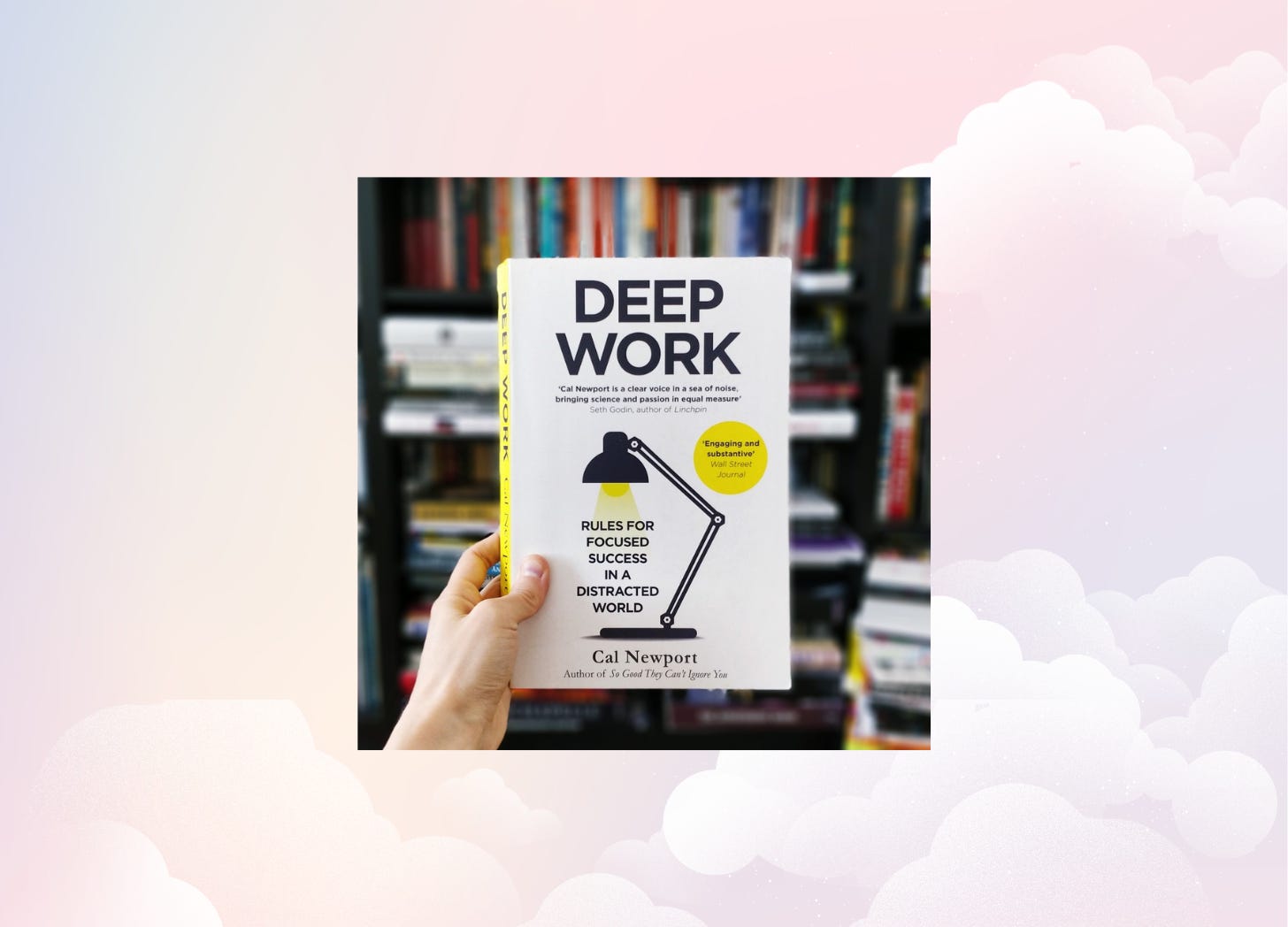
Deep Work by Cal Newport
"Leave the distracted masses to join the focused few"

What I did after reading:
I bought the Cold Turkey app that blocks usage of my entire laptop at specific times. I previously had a phone blocker but I have extended it to my laptop after reading this book
I started experimenting with daily deep work. I am now doing 30 mins every morning. In the past, I tried to jump straight to 90 minutes but always failed. I will take the book’s suggestion and start small. I will also start recording it physically on a card, also a recommendation from the book, and give myself motivation to complete the streak.
As the formula is time x intensity, I will commit to improving work intensity through ritualisation (which I previously did not believe in). My ritual is simple: I will look out my window for 2 minutes, clear my mind, and when the alarm rings I will start my 30-minute deep work window.
While I do not believe we can quit social media entirely, I am now more aware that I have the “any benefit” approach to using social media. This awareness does not make me ban myself from any of the existing ones, but it tells me which ones I need to double down on (LinkedIn) and the one I need to let go off (Twitter, which I was previously contemplating making an account…at least that loop is closed.)
4 modes of Deep Work
Deep work is not philosophical. It gets valuable things done.
Monastic philosophy: cut away distractions
Bimodal: deep work periods, min 1 a day
Rhythmic: make a streak, usually eg daily writing before work → not for novices
Journalistic: switch to deep work at any opportunity eg a cancelled meeting
Formula for high quality work
High quality work produced = (intensity × time spent)
Core Abilities for New Economy
Though book is pre-AI, the principles remain
We need to quickly master hard things
We need to produce at elite level (quality + speed)
#1 Work Deeply
Have rituals so don’t have to rely on willpower
Do things at the same time, the same way
Great creative minds think like artists but work like accountants. Waiting for the “Inspiration strike” is a bad way to work.
Rituals allow you to go deep fast & stay that way. Thinkers like Darwin did not have rituals just to be weird. There is method to the madness
Key questions
Where to work
What supports your work (coffee)
How will you work (e.g. timeframe)
Need to experiment, but it will be worth it
The grand gesture:
JK Rowling finishing the Harry Potter book in a luxurious hotel opposite a castle
Peter Shankman booked a business class flight and completed a manuscript
Writers building cabins in their own property to write and think
Distraction is destroyer of depth
Nowadays there are lots of open offices that promote serendipitous collaboration
Important to separate deep and shallow encounters, while acknowledging both are critical
Deep work still should take up most of the time, but make time to share. Do not share / collaborate at the expense of your own deep work
4DX – 4 Disciplines of Execution
Focus on the wildly important (1–2 things max)
Focus on lead measures: lead measures affect lag measures
Example: Deep work hours (leading) → # of papers published (lagging)
Keep a compelling scoreboard: physical artifact of deep work count
Cadence of accountability: personal weekly reviews, confront the reality and make adjustments
Idleness is necessary to get work done
Serious effort needed to produce something of value
Downtime actually helps to recharge energy needed to work deeply
Even if forcing yourself to work, evening work may not be important. Energy ↓, may just be busy light tasks).
Have a shutdown ritual: a plan to tackle work the next day
#2 Embrace Boredom
Don’t take breaks from distraction, take breaks from focus.
Eg if the internet is distracting, schedule when you will use it. Strictly do not use outside of scheduled times
Schedule internet use at home and at work
Improve your intensity of work. Use time blocks as a way to get deep tasks done. Start once a week and work from there
Memorisation of Cards
An act of focus, not memorisation
This is the method: 5 rooms, 10 items per room +2 (eg outside home, at doorstep) = 52 card
At each item, associate a person/thing to a corresponding card, eg. Donald Trump = king of Diamonds as he’s rich
Begin your mental walkthrough of the house. Encounter item, look at card, imagine person/thing next to the item.
#3 Quit Social Media
Network tool selection: The problem with the “any benefit” approach
Just because you can identify any benefit to use it, does not mean you should use it
Instead, use the craftsman approach. Identify factors that you value in professional/personal life. Adopt only if positives outweighs negatives
Pick your high-level goals: 2–3 core activities for the goal, and measure the network tool’s impact (high / low / negligible)
Law of vital few, 80–20 effect. 20% brings 80% of results
Run a 30 day experiment. If you decide to stop using it, just stop. Do not announce. You will then see the reality of what you miss out on (and not have people artificially respond to you by saying they noticed your absence)
Structuring your day
Treat time after work as a day in its own right (not just an epilogue)
Use it to ENRICH yourself instead of just seeking entertainment
Put more thought into your leisure time
Ensure you LIVE, not just exist
Rule #4: Drain the Shallows
Deep work is exhausting
Start with 1 hr/day for beginners and notice when it gets diminishing returns
Plan every minute of the day. This does not mean it’s rigid. If you have an insight to pursue and want to continue beyond time, you should
The idea is to remain thoughtful about time spent by recording and planning it
Fixed schedule productivity
Fix work hours/duration first. Work backwards to find the habits
Be clear on the criteria of how you spend your time in order to meet that fixed schedule
This can include being hard to reach
Direct others to filters e.g. your agent
Write emails that close the loop e.g. “If you reply xxx I will take as done not require more follow up”
Be clear on when you cannot respond e.g. I may not be able to respond to all emails that do not align with my priorities
On #1 Work Deeply - rituals and boundaries are important, but it's difficult when people around you don't see the importance of this.